


A new town, a new state, a new school. Will Rogers Elementary is old school in the truest sense. The building itself consists of two parallel rows of classrooms connected by covered concrete walkways. There is no gymnasium, no library, and no cafeteria. We spend all day every day, except for recess periods, sitting in chairs bolted to desks lined up and spaced in columns and rows, each of us our own little island. The wooden desk top with its oblong depression for our thick pencils is worn and scratched. I hook my feet on the wire shelf under my seat and trace capital and lower case letters, or circle stars or fish or frogs on purple-inked mimeograph sheets that are sometimes still damp. I press my nose into the fresh clean scent before taking one and passing the rest back to the student behind me.
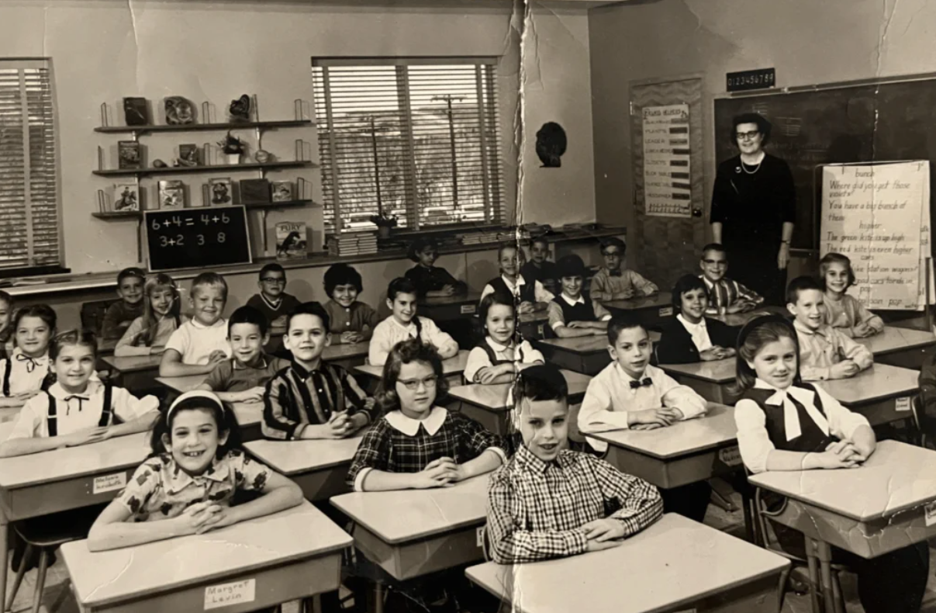
Mrs. Millington is old too. She looks like Aunt Mary with her big belly and dark hair pulled back into a tight shiny bun. She speaks in short, sharp sentences and paddles kids who misbehave with a flat wooden board with holes in it to make it sting. It hangs on the wall beside the chalkboard, a confusing reminder to sit still, be quiet, and follow directions.
Mrs. Millington is not warm or loving, but she is serious about reading. She sits with me and two boys whose bodies are in constant motion at a table in the back of the room every day. We turn the pages of thin paperback books with the stories of blue-eyed children, Dick and Jane, and their little dog, Spot. With one eye on us and one eye on the rest of the class, she points to words we miss. “Look again,” she says. “You know that word.” Soon the individual letters form words and the blond kids talk to each other (“Look at Spot go. Go, Spot, Go.”). Then they match the pictures (Look at Dick run. Run, Dick, Run). Something clicks that feels like magic and freedom, and I can choose books from a different shelf and read at my desk like the rest of the class.
Show-and-tell is the scariest part of the week. “Listen to her talk,” the kids whisper behind their hands in their Oklahoma drawl. They bring Barbies, diaries with locking clasps, toy tractors, cars, and trucks. I don’t bring anything to share. I don’t talk in class. It keeps me quieter than I might have been.
Second grade is so much better. I can read all of the books on the reading shelf. Mrs. Tomlinson plays the piano and the whole class stands and sings together several times a day. We sing This Land is Your Land, She’ll be Coming Around the Mountain, Old Susannah, and the Hokey Pokey. Some days we push the desks to the edges of the room to open up a dancing space in the center. We learn the Virginia Reel and how to square dance.
Best of all, Mrs. Tomlinson is young and pretty and she never yells or paddles. I am thrilled that her first name is Linda just like mine, and I ignore the snickers of “Teacher’s Pet” when she asks me to carry notes to the office or to the other Mrs. Tomlinson, her mother-in-law, who teaches Peter in 5th grade. I feel important walking alone on the wide, quiet walkway.
The best part of the day is read aloud when Mrs. Tomlinson reads about a little girl who lives in the big woods of Wisconsin. Every word comes to life in my imagination. I am with Laura and Ma gathering kindling, sewing clothing, and making food. I hunt with Pa and sit with Laura, Mary, and their baby sister, Carrie, as Pa tells stories and plays the fiddle after dinner. I smell the smells, hear the wolves, feel the cold. My spine prickles with fear, and I bask in the love, affection, and adventure of this family despite their hard life and strict rules.
In line to wash hands before lunch, a girl in front of me says something to her friend about adoption.
“I was adopted,” I tell them. I’d like to be included. I’d like to have a friend.
“No you weren’t,” Wendy dismisses me over her shoulder and turns back to her friend.
“Yes, I was,” I repeat. “I was adopted.” We go back and forth a little too loudly. Mrs. Tomlinson comes to see what all the fuss is about.
“Linda is lying,” Wendy says. “She says she was adopted.”
“But I was adopted.” I tell Mrs. Tomlinson. “I was.”
Wendy and her friends snicker in their southern drawl. “Listen to her accent.”
I remember the adoption, the courtroom, the judge, and I still stumble over my new name.
Mrs. Tomlinson calls home and arranges a parent-teacher meeting. I sit outside the classroom on the cool concrete while she and Mom talk. I am in trouble, but I want to be a good girl who doesn’t get paddled at school or whacked with a wooden spoon at home. I don’t like yelling.
“Settle down in there, girls.” Mom hollers from the living room after bedtime. “Don’t make me come in there.” Trouble sometimes comes out of the blue. Like after church when the three of us race to the front door to be first to the bathroom. We prance from foot to foot, angling to beat the others. “I was here first.” I complain. “No, I was,” says Peter. “But I can’t hold it,” whines Beth. None of it matters when Jim comes up the walkway from the car and swats us out of the way. He hisses, “I’m the one with the key, assholes.”
After the parent-teacher meeting mom takes me by the hand and walks briskly to the car. “Yes, you were legally adopted,” she says, “but this is a private family matter, and we don’t tell strangers family business.”
“Mrs. Tomlinson isn’t a stranger.”
“I know you love her, Linda, and it’s clear she loves you, but we don’t talk about family business outside the family.” She is firm, her mouth a straight line, her eyes straight ahead on the road. We don’t talk about family business inside the family either.
Later she tells Jim about the meeting, and I overhear her tell him that Mrs. Tomlinson would take me home in a heartbeat. That she and her husband can’t have children of their own because her husband was paralyzed in a farm accident last fall when he fell between a hay baler and trailer. This makes me love Mrs. Tomlinson even more, and I imagine life at the Tomlinson’s filled with read aloud, singing and dancing.
On the bus one day, I overhear two girls in the seat behind me whispering about divorce. They are talking about a boy in Peter’s grade, Billy, who just got off the bus and crossed the road to go into an old, run-down green clapboard house with peeling paint. The shutters are falling off, the grass needs to be cut, and the bushes are overgrown. “His parents are divorced,” they say. “That’s why Billy is such a bad kid.”
At home, I find mom in the kitchen, “What is divorced?”
She turns sharply toward me, eyes flashing electric blue, “Where did you hear that word?” She scolds me like it is a swear. When I tell her about Billy, she says, “We don’t talk about d-i-v-o-r-c-e. It is a private family matter.” That is the end of the conversation.
Peter only shrugs when I ask him. “His dad left. He just lives with his mom.” He rides his bike out of the garage. My questions about dads and divorce go unanswered.
So vivid and perfectly understated.
Wonderful storytelling!