

Father Jim

I remember the years in Scranton as comfortable and nurturing. We steeped in The Wonderful World of Disney, Captain Kangaroo, and the rhythms and routines of Catholicism. There were rules to follow, a catechism for living a good life. If we were good little girls, we could expect good things to happen. Peter started school at Holy Rosary, a short walk away, and Beth and I spent two years attending a Montessori preschool at Our Lady of Fatima. It couldn’t have been too far away, but it required what seemed like a long winding drive. Sometimes Mom drove us, always in a hurry, speeding around curves in her tiny green car. Sometimes cousin Edward drove us in his red convertible with the roof down. Sometimes Uncle Tony, Aunt Rita, Uncle Patty, or Grandpa took a turn dropping us off or picking us up. Beth and I sat in the back seat and watched the green hills roll by, the shining river at the bottom of the valley. We told stories about the hermits we imagined living in the shacks we glimpsed tucked into the hillside surrounded by large expanses of forest.
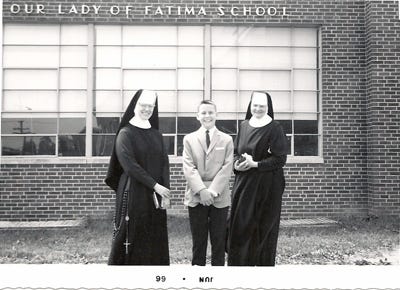
The nuns of Our Lady wore long black habits with wide white collars. Another white band tucked their hair out of sight and crinkled their faces into soft folds when they smiled. Their arms emerged like magic from oversized sleeves and they seemed to float around the room with their feet hidden from sight. We learned to sit in a circle to sing songs, count in Spanish, and learn the routines of the day and week. We set and cleared the table for snacks, poured juice for each other, washed and dried dishes, and then put them away. We learned to take care of the classroom materials. We made choices purposefully, played on a mat, and put them back where they belonged when we were finished. Everything had its place, including us. The nuns created a sense of belonging and importance. It seemed to matter that we were there.
* * *
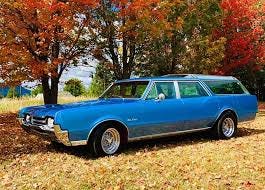
Then one day we are dressed up like we are going to church, but it isn’t Sunday. There is a sense of urgency, an unusual degree of hustle and bustle.The grown-ups are short and terse with each other. Bags, boxes, and pillows are piled on the front porch and then loaded into an unfamiliar blue station wagon. Peter, Beth and I squeeze together into the back seat each hugging a pillowcase filled with our clothes and pajamas. Our feet rest on other bags and pillows. Father Jim drives, but instead of the usual black collar and white square, he wears a jacket and tie. Mom sits beside him in a new blue dress and pillbox hat. Peter, Beth and I fidget quietly on the drive. We elbow each other for more room, but no one talks. No one asks where we are going.
We stop in front of a low house, almost invisible behind overgrown shrubs. Mom turns to us. “Sit tight. We won’t be long.” She and Father Jim get out of the car and disappear into the house. We roll down the windows and sing our hellos to Auntie Anne who has pulled up behind us in her little blue bug. She leans in with kisses for all and then follows Mom and Father Jim into the house behind a swinging sign that Peter reads, “Justice of the Peace.”
“Just us of the piece?” Beth and I giggle, but Peter just shrugs. At nine, he has no patience for the silliness of a five- and six-year-old. The grown-ups return to the car all smiles, and we tumble out for pictures. Beth and I lean into each other. Peter stands to the side with Mom and Father Jim behind us. Auntie Anne clicks the black instamatic camera. She gives everyone a big hug and kiss, leaves us swimming in the scent of her face powder and perfume, and with a cool smudge of her lipstick on our cheeks.
“Congratulations,” she says to Mom as she gets into her car, “Good luck.” As she pulls away, she calls out to us. “You kids be good.” Her pale arm waves out the window, and with a “beep beep” of the horn and a puff of cigarette smoke, she leaves us to this fuzzy transition. It is indistinct, yet sharply defined like a fulcrum, like bumping into something in the dark.
We drive for a long time to a squat cottage hidden behind giant shrubs and under a low green roof. We carry our pillows and pillow cases to the front door.
“Isn’t this exciting?” Mom says. “A new house.” But she opens the door to the musty smell of someone else’s furniture. The living room is stuffed with a sagging couch, a wing-backed chair, and a low scuffed coffee table. Shelves on either side of the stone fireplace hold haphazard stacks of books, games and puzzles.
“Whose stuff is this?” I ask.
“It comes with the rental,” she says, her voice strains with cheeriness. “We get to use everything here. “
“Where do we sleep?” Peter asks. We hold our pillows against our bellies and peek around the door jamb into a room with a bunk bed and a single twin.
“This is your bedroom,” she says.
“For all three of us?” Peter asks. He had his own room at Aunt Mary’s house.
“I get the top bunk.” I say and start up the ladder.
“No, I get it,” Peter says. “I’m the oldest.”
“No fair,” says Beth. “I want the top bunk.”
“You are the oldest,” Mom says to Peter, “but the girls get the bunk beds. You get the bed by the window and we’ll string up a curtain for privacy.”
I test out my pillow on the lumpy mattress and survey the tiny yard riddled with the roots of a giant tree with low branches perfect for climbing. It feels like we are playing house, but we unpack real clothing into a scratched bureau with sticky drawers.
While we explore the yard, test climbing branches, and find hiding spots under the shrubs, they hang a sheet on a wire across the middle of the bedroom. Peter ducks under it to get to his side of the room and blocks our way when we try to follow.
“No girls allowed,” he says, but I can see over the divider from my top bunk.
***
The first dinner in the house is strangely formal. “Time for dinner,” Mom calls and we find our places around an oval table in a cramped kitchen. Cooking smells have replaced the vacant odors of the cottage. Mom places a bowl of green beans and a basket of rolls in the middle of the table. “Ah, ah, ah,” she says as I reach for a roll. “Just wait.” She brings a platter of meatloaf to the table and sits down. “Elbows off the table,” she says as we lean in ready to eat.
“Sit up straight,” she chides. “No hunchbacks in this family.” But she is all smiles. “Oh, will you look at that,” she says, “I forgot my apron.”
Apron? Mom doesn’t wear an apron. She stands to untie the white apron with oversized pockets and folds it over the back of her chair. This is different.
“Shall we say Grace?” She reaches to hold hands with Father Jim on one side and Peter on the other.
Grace? We don’t say grace. But Father Jim is sitting at this table now in regular clothes, and we hold hands and bow our heads. I dart my eyes from side to side to glimpse my brother and sister. Father Jim says a prayer of thanks. I guess this is what we do now.
We pass the food around the table like Thanksgiving dinner. “Wait until everyone is served.” Mom says.
“Delicious,” Father Jim says after his first bite. He smiles at Mom. “Your mother did a good job, didn’t she?” He smiles at us. We nod with full mouths.
“Now that we’re married…” Mom looks at us and then looks at Father Jim.
“You can call me dad,” he says. “I’m your dad now.” They smile at each other.
Dad? We look at each other, nod our heads, chew and swallow our food. Maybe Peter remembers our father, but Beth and I don’t remember ever having a dad. We don’t say a word. Things are different now.
We live in a cottage on a dirt road, and we start at a new school tomorrow.
Thanks for sharing this, Linda. So many reactions: OMG and WTF arriving first. Then I ache for those confused kids, and for your mom who married a person she had to perform for. Then a little wonder and awe creeps in for two people willing to transgress the church’s iron will. Then worry that your mom and you were victims of the abuse of clerical power. Then some horror that children really have so little power. Then back to WTF.
You simply describe an experience. But you also describe the whole world. Powerful.